By Oana Harrison
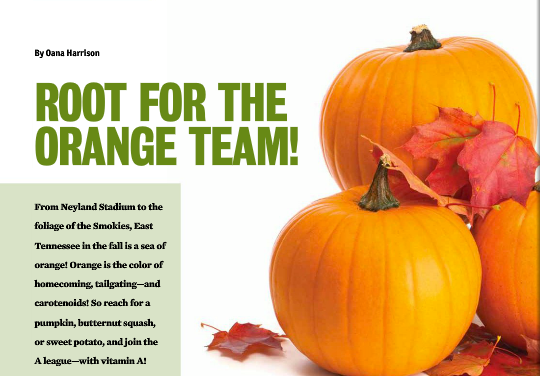
It’s fall time in Knoxville and the town turns orange. From Neyland stadium to the foliage of the Smokies, it’s a sea of orange! Orange is the color of homecoming, tailgating and…carotenoids. So reach for a pumpkin, butternut squash or sweet potato: the A league of vitamin A.
***
It’s fall time in Tennessee and we can all breathe a little easier: some of us perhaps because the kids are back in school but mostly because the hot days of summer are being blown away by refreshingly cooler days and nights. Fall time is definitely football time around here. It’s a time for homecoming, tailgating and enjoying fall festivities, foods… and anything orange!
September and October bring with them a cornucopia of fruits and vegetables. Tradition dictates that we should enjoy pumpkins in any shape of form, alongside corn and beans. But if you look deeper in fall’s horn of plenty you will also find sweet potatoes, butternut squash, winter squash, parsnips, turnips, and rutabagas. So reach in, gather the goodness and score some extra health points this season!
Pumpkin
You cannot have fall celebrations without pumpkin. The benefits are too many to mention: pumpkin pie, pumpkin bread, pumpkin ravioli, pumpkin latte…. OK, but in all seriousness, pumpkin is a super food, packing antioxidants and vision-friendly nutrients. The bright orange color is an indicator of carotenoids, such as beta-carotene, which the body converts to vitamin A, and which is essential for eye health. Known for its immune-boosting powers, beta-carotene has also been linked to preventing coronary heart disease.
There are many ways to consume pumpkin and cooking this vegetable won’t diminish its healing powers. One cup of canned pumpkin has seven grams of fiber, three grams of protein, and provides half of the daily value of vitamin K, which may reduce the risk of some types of cancer. Pumpkin is rich in vitamin C, potassium and it contains the compounds lutein and zea-xanthin, which are good for the eyes. To add to its record, pumpkin is also a low calorie food, with only 49 calories and one gram of fat per cup. And if you are still not convinced of the pumpkin’s powers, add the B-complex group of vitamins (like folates, niacin, vitamin B-6, thiamin and pantothenic acid) to the list, along with minerals like copper, calcium, potassium and phosphorus.
As with many other vegetables, the hidden treasure is in its seeds. Pumpkin seeds are an excellent source of dietary fiber and mono-unsaturated fatty acids, which are good for heart health. Packed with protein, magnesium, potassium, and zinc, pumpkin seeds provide numerous health benefits. Studies suggest that vitamins found in pumpkin seeds can block the enlargement of the prostate gland and lower the risk of bladder stones. Their high content of compounds called phytosterols, inhibits the intestinal absorption of cholesterol, which reduces LDL (“bad” cholesterol), and thus helps prevent cardiovascular disease. In addition, the seeds are concentrated sources of protein, minerals and vitamins such iron, niacin, selenium, and zinc (71% of the recommended daily value in only 100g).
If your favorite team gives you reason to frown and be sad, pumpkin can help! A handful of pumpkin seeds and a cup of pumpkin will keep your outlook positive and your face wrinkle-free. How? Pumpkin seeds are rich in the amino acid tryptophan, which is important in production of serotonin, one of the major contributors to a good mood. Carotenoids found in pumpkin contain free-radical neutralizing powers that improve skin health, all while keeping cancer cells at bay.
Butternut Squash
Another superstar in the Cucurbitaceae family is the butternut squash. In addition to the beta-carotene, minerals and B-complex vitamins, it provides 354 percent of the recommended daily value (RDV) for vitamin A. Butternut squash contains both soluble and insoluble dietary fiber. The first type prevents constipation, while the later slows the absorption of carbohydrates and lowers bad cholesterol. One cup of butternut squash contains 3 grams of fiber or 8 percent of the recommended daily intake for men and 12 percent for women.
Butternut squash delivers 13 percent of the daily value of vitamin E, a fat-soluble and antioxidant supporting cell wall structure. It also contains vitamin C, which is water-soluble and thus is easily absorbed in body fluids, where it neutralizes free radicals, including those damaging skin cells. One cup of butternut squash packs 32 percent of the RDV of vitamin C for men and 39 percent for women.
If you like working out but don’t like being sore afterwards, butternut squash can help. One cup of this orange goodness delivers 10 percent of the RDV of potassium, 11 percent of magnesium and 7 percent of calcium, reducing post-workout soreness and replenishing essential minerals.
Like pumpkin seeds, butternut squash seeds contain the mood-enhancing tryptophan, along with proteins and minerals. Butternut seeds are a good source of dietary fiber and mono-unsaturated fatty acids, benefiting heart health.
As an added bonus, butternut squash has the longest storage potential of all squash varieties. Its sweetness increases over time, along with its nutty flavor. If stored in a cool and dry place, you can enjoy butternut squash all the way through February.
Sweet Potatoes
Sweet potatoes are a Native American plant packed with calcium, potassium, and vitamins A and C. Sweet potatoes are often confused with yams, but yams are large, starchy roots grown in Africa and Asia. Although yams can grow up to 100 pounds, the smaller sweet potatoes deliver more nutritional value than their larger counterparts. Orange-colored sweet potatoes may be one of nature’s unmatched sources of beta-carotene. To fully enjoy the beta-carotene benefits, include some fat in your sweet potato-containing meals (3-5 grams of fat from healthy sources such as olive oil).
Sweet potatoes have a high ability to raise blood levels of vitamin A. They provide 15 percent of vitamin A needs, along with 47 percent of vitamin C, while only adding less than 3 grams of sugar to the intake.
Sweet potatoes contain unique storage proteins called patatins and sporamins. Spoaramins are produced as a self-defense mechanism, to help promote healing whenever potatoes are subject to physical damage. By consuming sweet potatoes, we borrow sporamins, which help prevent cell damage. Sweet potatoes also contain an enzyme that converts most of their starches into sugars as the potatoes mature. Because of this fact, the natural sweetness will continue to increase during storage. The same applies when sweet potatoes are cooked. Steaming or boiling will preserve the anthocyanins, which are antioxidant and anti-inflamatory nutrients. In addition, steaming will deactivate peroxidase enzymes, which are known to destroy the useful anthocyanins.
Cornucopia Extra Points
With mild weather and plenty of sunshine, Knoxville area farms have a lot to offer at harvest time. We’ve talked with Bob Due of Terraced Garden Farms who shared with us some of his fall favorites: sweet potatoes, butternut squash, Dikon radishes, Kohlrabi, cabbage, broccoli, cauliflower, beats, and carrots. “People ask me ‘do you have this?’ or ‘do you have that?’ but I only grow what I like.”
Growing up on an organic farm in southern Indiana, all Bob ever wanted to do since he was five was farm. With the discipline gained in the Navy, his training as an industrial technician, and his passion for antique rotary tillers, farming was a natural fit. Bob trained in the Albrecht system of soil balance, which analyzes the minerals available and recommends exact levels of each component in order to achieve a balanced and therefore healthy soil. “Healthy soil provides healthy plants. Because of the way I farm I have developed a reputation for having high quality produce. If it doesn’t meet my standards, I don’t bring it to the market,” said Bob.
“I have a hillside and found that terraces are a great way to make this type of landscape into a garden. I use hay mulch, which keeps moisture in, protects the plants from frost, and controls weeds. The slightly sloped terraces make it easy for water from excessive rain to gently run off and down the ends without damaging the plants or eroding the soil.”
“One year I had more sweet potatoes than I knew what to do with them,” said Bob. So, he decided to go to the market and the rest is history. “Have you heard about Dikon radishes?,” asked Bob. “They are oriental radishes that can grow fairly big. First year I grew them, no one wanted to buy them because they didn’t know what they were. I had a wonderful crop and they were so darn sweet that I was eating them raw. I found a smaller variety to grow, I let people taste them and now they are selling really well. They are just as mild as can be and the leaves are edible as greens.”
Another fall vegetable is Kohlarbi, which translates as “cabbage turnip” from German. It’s similar to turnips in consistency but it grows above the ground. “If they are good quality, they should be nice and crunchy – just peel the skin and eat them like an apple. You can slice them up and eat them with party dip, roast them, or mash them,” recommends Bob.
When it comes to cooking butternut squash, Bob keeps it simple. “I’m not a complicated cook: I take the butternut squash, slice it down the middle, leave the seeds in, place it face down, cover it with foil and bake it. After it’s baked, the seeds come out easily; you don’t have to fight them. Then you want to add a little butter, and scoop it out of the shell.” Sweet potatoes can be prepared similarly, however, steaming them lightly is best. If they are small, they are a great snack. You can eat the skin too or give it to your dogs – it’s good for them and they love it.
“If the vegetables are grown correctly, on good balanced soil,” says Bob, “you end up with a lot of flavor, a lot of sweetness that will not be there in a store-bought vegetable.” During the last several years, the farmers’ markets in and around Knoxville have grown and provide convenient and fun access to fresh fruit and vegetables from May through November. All in all, fall is fantastic time for fresh food, so join right in and have a healthy season kick-off!
 Oana Dance